

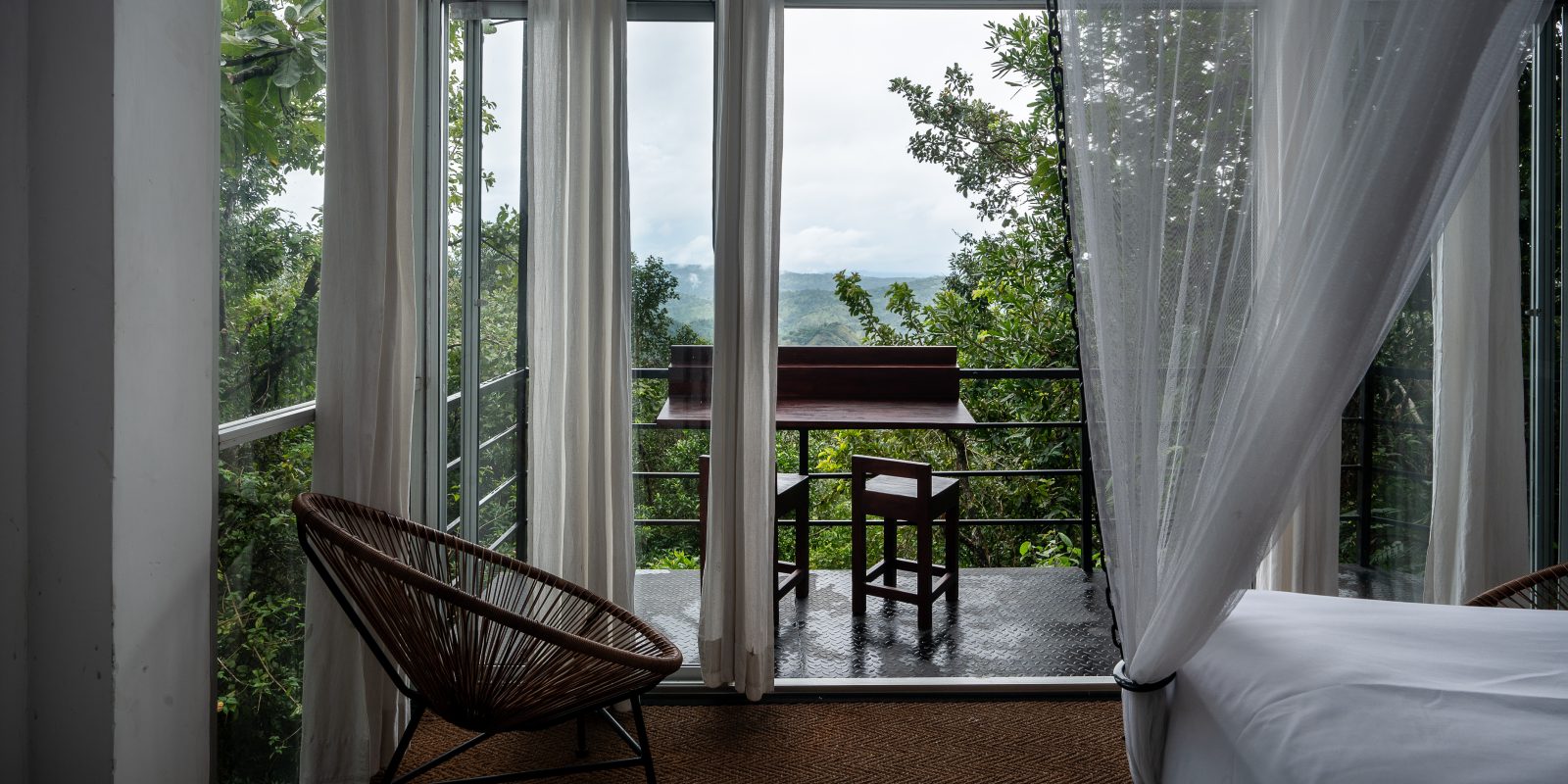
Imagine waking up in the mountains and discovering that the landscape around you belongs to more than just the people staying there.
The forest has its own inhabitants.
The streams have their own life.
The trees have their own rhythm.
And sometimes, one of Sri Lanka’s most elusive predators moves through it all.
At Treehouse Chalets, leopards have been sighted on the property. These sightings are a powerful reminder that the 10-acre natural setting is not simply a backdrop for a holiday. It is part of a living landscape shared with wildlife.
The Leopard Beyond the National Park
The Sri Lankan leopard, Panthera pardus kotiya, is endemic to the island.
Although leopards are often associated with national parks, they also move through a wider mosaic of forests, plantations and human-dominated landscapes across the Central Highlands. Belihuloya is part of this broader ecological story.
UNESCO identifies the leopard as one of the important species associated with the Central Highlands, while research has shown that leopards can persist outside protected areas in landscapes where natural habitat and wild prey remain available.
A 2026 study of leopards in Sri Lanka’s Central Highlands found that more than 85% of their diet consisted of wild prey. This suggests that even landscapes influenced by human activity can retain important ecological value.
That changes the way we think about coexistence.
The question is not simply: “How do we keep leopards away from people?”
It is also: “How do we create landscapes where people and wildlife can safely exist alongside one another?”
When a Leopard Enters the Property
A leopard does not recognise the boundaries of a hotel. It does not know where a property begins and ends. To the animal, a forested garden, a streamside path or a wooded slope is simply part of its habitat and movement range.
This is precisely why the leopard sightings at Treehouse Chalets are so meaningful.
The property is set within approximately 10 acres of natural surroundings in Belihuloya. It is not a wildlife enclosure, and the animals are not brought in, fed or attracted to guests. They move through naturally.
A leopard sighting here is therefore not a staged encounter. It is an unexpected moment of connection with the wider landscape, one that must always be approached with respect and caution.
The Wider Lesson
Research into human-leopard interactions in Sri Lanka’s Central Highlands has already shown why this matters.
As people and leopards increasingly share landscapes, encounters can become more frequent. Conservation organisations and researchers are therefore working to understand leopard movement, protect habitat connections and develop practical approaches to coexistence.
The Wildlife and Nature Protection Society’s Multi-Regional Leopard Research and Conservation Project includes Belihuloya among its research regions.
That is significant.
Belihuloya is not merely a beautiful place where leopards happen to occur. It is part of an active conversation about how people and wildlife can share changing landscapes.
The sightings at Treehouse Chalets add a valuable local dimension to that conversation. They show that wildlife can move through a hospitality setting when natural habitat remains available and human activity is managed responsibly.
What Does This Mean for Treehouse Chalets?
It changes the philosophy of a nature hotel.
Instead of asking: “How much wildlife can we show our guests?”
The better question becomes: “How can we let guests experience wildlife without changing its behaviour?”
That distinction is everything.
At Treehouse Chalets, the wildlife experience extends beyond large mammals.
Resident naturalist-led bird walks introduce guests to the avifauna of the landscape.
Night walks and camera trapping offer glimpses into the nocturnal world, including civets, porcupines, pangolins, tree frogs and barking deer.
The Junior Naturalist Programme introduces children to the relationships between plants, animals and their environment.
The objective is not simply to see.
It is to understand.
A leopard sighting should be treated in the same way. It is not a promise, a performance or a guaranteed attraction. It is a rare privilege that comes with responsibility.
A Different Idea of Luxury
Perhaps this is where nature and luxury meet.
Luxury does not have to mean controlling everything around us.
It can mean having the privilege of entering a landscape without needing to dominate it.
A leopard walking through the property is not an amenity.
It is a reminder.
The land was here first.
The forest is still functioning.
And the privilege of staying there comes with a responsibility to respect what already exists.
Let the Leopard Remain Wild
When a leopard crosses the landscape at Treehouse Chalets, the best outcome is not necessarily a perfect photograph.
It is that the leopard continues on its way.
Unfed.
Undisturbed.
Unharmed.
Still wild.
That is what coexistence should mean.
And perhaps one of the most powerful things a nature-focused hotel can offer its guests is not a guaranteed wildlife sighting, but the chance to understand why the animal was able to pass through in the first place.
At Treehouse Chalets, the leopard sightings are a reminder that Belihuloya is more than a mountain retreat.
It is a shared landscape, one where people can stay, explore and learn, while wildlife continues to move freely through the forest.